LUX-ZEPLIN
The LZ Collaboration is building what will be the world's largest dual-phase xenon time projection chamber for dark matter detection. This detector will have a 7-ton liquid xenon target and will run at the Sanford Underground Research Facility in Lead, South Dakota, with science operations beginning in 2020. Professor Dahl is currently the LZ Instrument Scientist, and the Dahl group works with Fermilab on the xenon handling and control systems safeguarding the >$10M payload of the experiment. The Dahl group is also investigating the effect of rare electron recoil topologies on background discrimination in xenon TPCs.
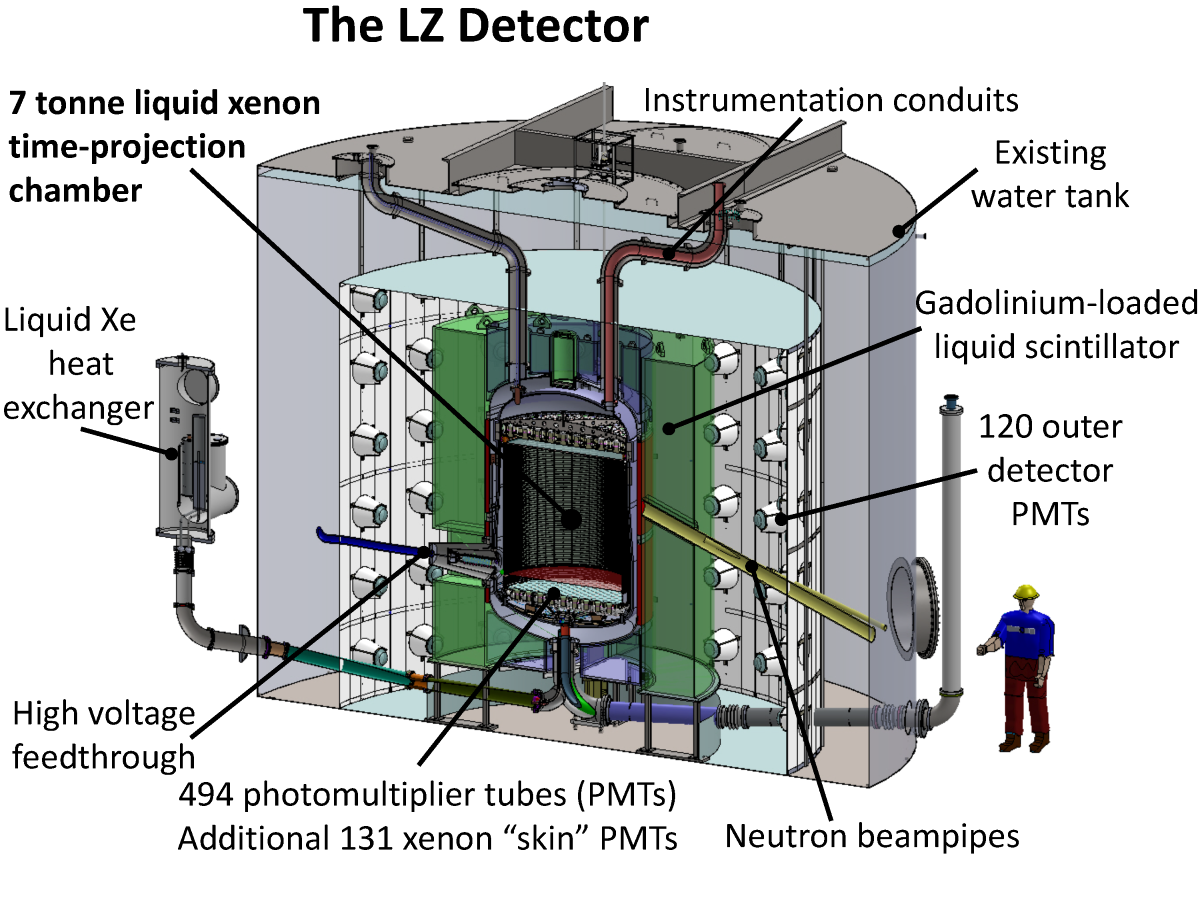
LZ detector located nearly 1 mile underground in the Sanford Underground Research Facility (SURF) in Lead, South Dakota.
Scintillating Bubble Chambers
The SBC Collaboration is developing a new technology for direct detection of 1-10 GeV dark matter using liquid noble bubble chambers. These detectors offer both the event-by-event energy resolution provided by liquid argon (LAr) scintillation, and a bubble chamber's extraordinary insensitivity to electron recoil (ER) backgrounds. The Collaboration has commissioned a 10-kg calibration bubble chamber at Fermilab, which is expected to start data-taking soon. Another functionally identical and radiopure chamber is also being developed at SNOLAB, for the first dark matter run using this technology.
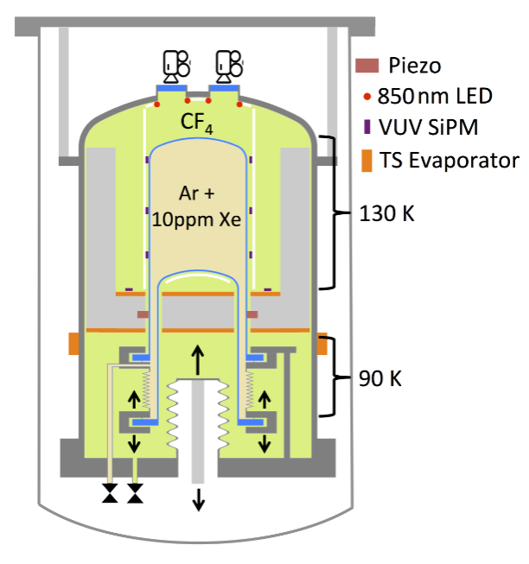
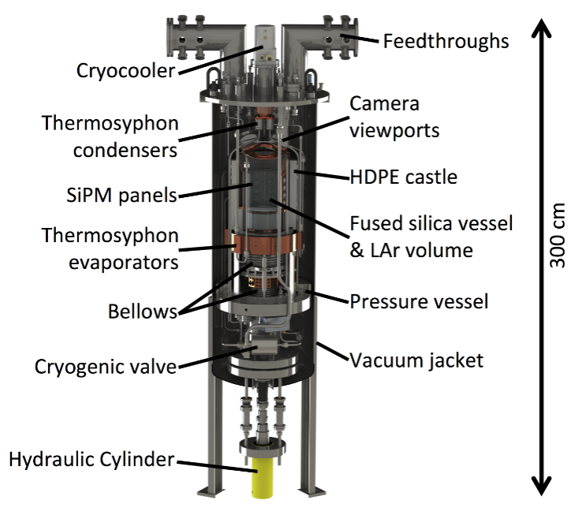
Schematic and rendering of SBC-LAr10 detector, commissioned 100 meters underground at Fermilab, Illinois.
Talks
APS 2026
(Zhiheng Sheng) First Bubbles from the Scintillating Bubble Chamber Experiment:
APS Schedule,
Slides.
(Dan Pyda) The SBC Dark Matter Experiment and Calibration Plan:
APS Schedule,
Slides.
Calibration paper: E. Alfonso-Pita et al 2026 JINST 21 P03020
Bubble animations:
single bubble,
multi bubbles